
Lilit Insight
#btw17 | Twitter — campaigning in 140 characters
Twitter has become indispensable to politics. But how do parties and politicians perform on the social media platform during an election campaign?
The microblogging service Twitter has become almost indispensable in politics. The platform is especially prominent in the USA — and not just since the country acquired a president who tweets wildly. In this article, we look at Germany’s political parties and politicians on Twitter, including Martin Schulz, Christian Lindner and Beatrix von Storch. Twitter’s special feature: tweets are limited to a small number of characters. Users must therefore get straight to the point. As social media experts we have our Lilit tips ready at the end of the article. They are useful not only for politicians, but also for businesspeople and associations!
A niche medium with political significance
In Germany, Twitter is considered a niche medium. According to the ARD/ZDF online study 2015–2016 only around five percent of German internet users use Twitter at least weekly. Nevertheless, Twitter plays an important role in German politics: all major parties are present, and around 57 percent of Bundestag members have a Twitter profile. Journalists are also represented at an above-average rate. Twitter sets agendas, ignites scandals and launches political discussions. Particularly good or controversial tweets can reach a broad audience beyond the platform through journalistic coverage. The latest example is the tweet about mini-jobs by CDU secretary general Peter Tauber. Twitter gives parties the opportunity to distribute their own content, reach journalists and opinion leaders and thereby shape political public debate around their issues. But what do parties make of this opportunity? How do they use Twitter? https://www.lilit-kommunikation.de/wp-content/uploads/2017/08/IMG_2358.jpg
#btw17: the hashtag for Germany’s federal election
Hashtags are especially important on Twitter. They label tweets, organize them by topic and make them easier to find. For major events such as elections, it is advisable to use the relevant established hashtag — for Germany’s 2017 federal election, that is #btw17
Skilled use of Twitter — across party lines
Parties’ accounts show how firmly Twitter has become established in politics. All major parties know how to use Twitter and are easy to find. They post regularly, address substantive political issues and get the essentials across concisely. Importantly, they use relevant hashtags and tag those involved or include background links. Most parties also regularly retweet posts — often from their own politicians, regional branches and youth organizations, but also from journalists and media outlets. They live-tweet important events, posting key statements from speeches immediately. In short, most parties offer a good mix of content. So we take a closer look at the parties’ tweeting: 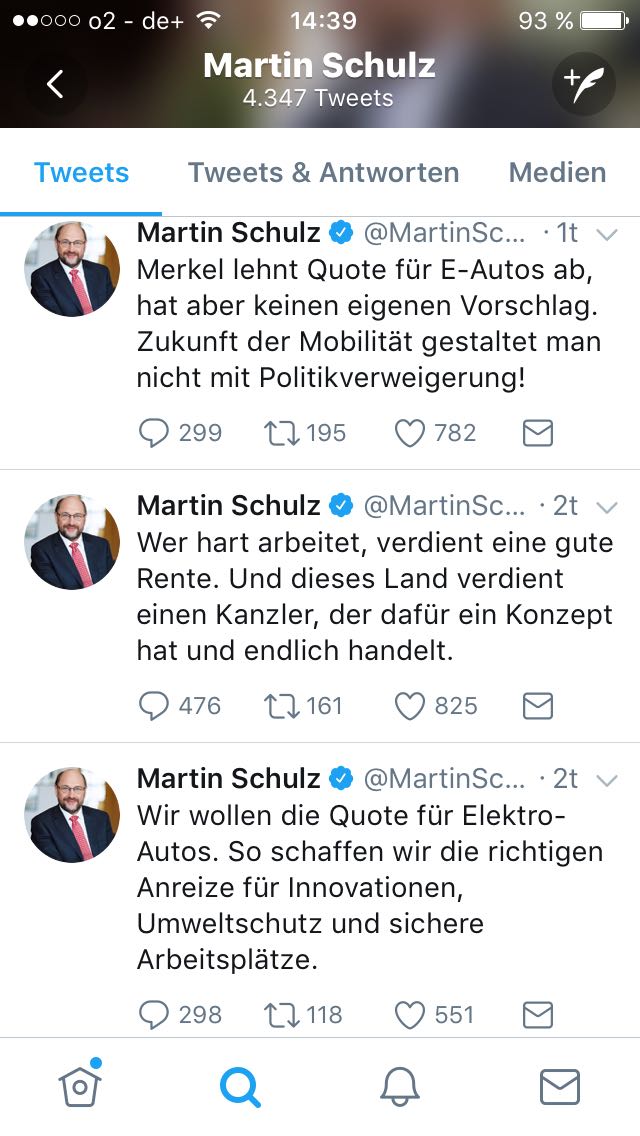 Screenshot: @martinschulz on Twitter
SPD: #schulzzug and #zeitfuermartin
With #schulzzug, the Social Democrats put their lead candidate Martin Schulz center stage and convey momentum and change. The hashtag successfully established an image that was repeatedly picked up. Other hashtags include #zeitfuermartin, #esistzeit and #ZukunftSPD. Here, however, less might be more: it remains unclear when each hashtag should be used and which is the campaign’s main hashtag. And what about the lead candidate? Martin Schulz tweets about 2–3 times a day, mostly political statements. Notably, he almost never includes hashtags or links. He thus forgoes important, characteristic Twitter functions, although it does make his tweets recognizable. Overall, however, his Twitter feed feels somewhat monotonous and very text-heavy.
CDU: what does #fedidwgugl actually mean?
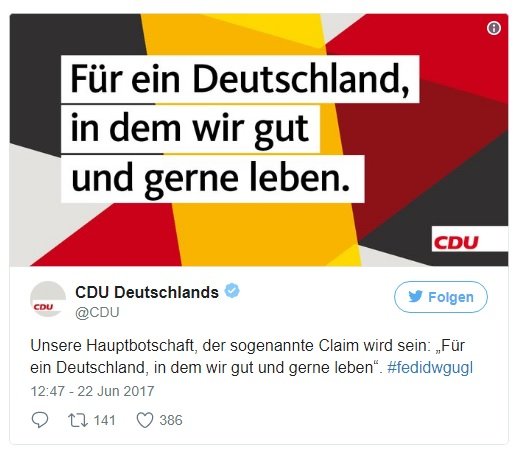 Screenshot: @CDU on Twitter The CDU used hashtags for a special campaign coup. Its politicians began using the cumbersome hashtag #fedidwgugl without explaining it, catching users’ attention. The answer came when the election posters were unveiled: “For a Germany in which we live well and happily” — the CDU’s election slogan, with its matching hashtag #fedidwgugl. Whether you find it clever or silly, almost everyone knows it after the party’s stunt. And that is the point: attention and recognition. Despite Twitter’s political importance, CDU lead candidate and Chancellor Angela Merkel has no presence on the platform so far. The CDU nevertheless has successful tweeters, including Peter Altmaier and Peter Tauber. Altmaier tweets interactively, reacts and replies to other tweets and addresses users directly. He could tweet more often, though: several days sometimes pass between his tweets. Peter Tauber tweets and retweets more frequently. For example, you can currently follow his door-to-door campaign on Twitter. Tauber also sometimes uses “negative campaigning,” tweeting attacks on the SPD. Voters do not always appreciate that, however.
The CSU on Twitter — room for more variety
#miasanbayern and #löwenstark: on Twitter, the CSU again uses hashtags familiar from other platforms. For the federal election, it also uses #klarfuerunserland. One good feature is that the Christian Social Union repeatedly links to its content on other social media channels. While live-tweeting an event, it might point to the live video on Facebook, for example, connecting the platforms sensibly. Looking at the CSU’s recent tweets, many are similar and revisit the same topics. What is inadvisable on other networks is unproblematic on Twitter: it is fast-moving and the feed is constantly updated. Repeated similar tweets on a topic go unnoticed and can even help ensure the content actually reaches users. Still, the CSU could offer a little more variety: its page has hardly any retweets and little outside content, which could be an engaging addition to its own. Neither party chairman Horst Seehofer nor lead candidate Joachim Herrmann has a personal Twitter profile. Dorothee Bär, however, has a successful presence with over 60,000 followers. A look at her profile reveals almost nothing but retweets and little original content. Andreas Scheuer is quite different: he mainly posts his own statements or occasionally retweets CSU content. His frequent attacks on other parties and politicians stand out, such as saying Schulz speaks “totally implausibly and irresponsibly” or referring to a “hypocritical and dishonest ideological crusade by the Greens against the automotive industry.” 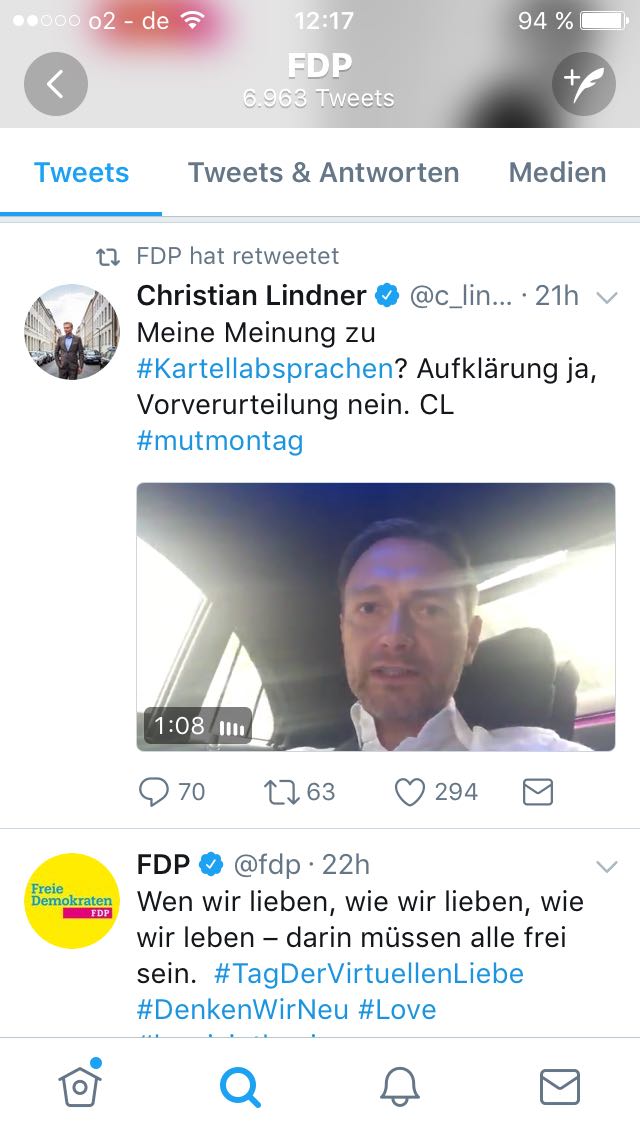 Screenshot: @FDP on Twitter
Young and innovative — the FDP and its lead candidate
One distinctive Free Democrat format is the series “Christian Lindner asks Alexa,” with the hashtag #CLundAlexa. Lindner asks the online voice assistant Alexa about German laws. This gives the FDP regular content matching its young, tech-savvy image. Its federal election hashtag also fits that young, innovative image: #DenkenWirNeu. The FDP’s image is shaped above all by its lead candidate Christian Lindner. Naturally, he is on Twitter too and currently has 141,000 followers. Particularly positive are his regular videos, in which he spends a few minutes discussing topics such as Russia policy or collusion in the automotive industry. These are not professionally produced videos. Instead, Lindner films himself with his phone camera, conveying closeness and authenticity. And, right now: Lindner lets the internet interview him. Users can ask him questions under #HalloChristian, which he will answer in a later interview. He thereby presents himself as approachable while emphasizing the call for “digital first.”
#darumGrün — how the Greens present themselves on Twitter
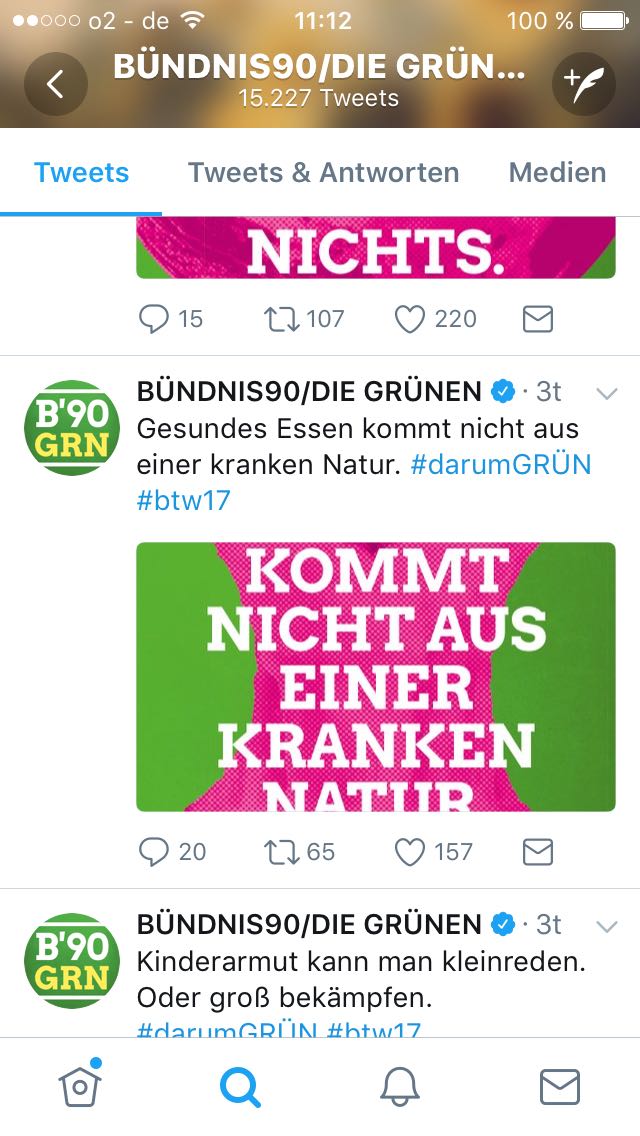 Screenshot: @die_gruenen on Twitter Alliance 90/The Greens tweets regularly and with variety about the federal election under #darumGrün. One issue stands out, however: they often post images and videos that do not fit Twitter’s format and are therefore cropped in the preview. It would be better to adapt and publish landscape or square images and videos. While lead candidates Katrin Göring-Eckardt and Cem Özdemir tweet about typical Green topics, Green politician Volker Beck, for example, focuses on his two core issues. He tweets almost exclusively about LGBT and Israel. This makes his feed distinctive, although he probably does not reach a broad audience this way.
#LustaufLINKS: the Left also impresses on Twitter
The Left also presents varied content on Twitter. One interesting example is a new video series on “What can we change,” promoted through Twitter among other channels. For the federal election, the Left uses #LustaufLINKS. Lead candidate Sahra Wagenknecht tweets successfully to 150,000 followers, but somewhat monotonously: her feed mainly contains article links. Fellow lead candidate Dietmar Bartsch offers a better mix, although he posts a notably large number of videos. The party’s co-chairs also tweet. Bernd Riexinger often comments on other politicians’ tweets, making good use of Twitter’s interactive potential. Alongside politics, Katja Kipping sometimes posts everyday experiences, such as “When the train I wanted to take is suddenly canceled and the DB information app crashes at the same moment, all that helps is staying calm.” This makes her more approachable.
The AfD: #TrauDichDeutschland
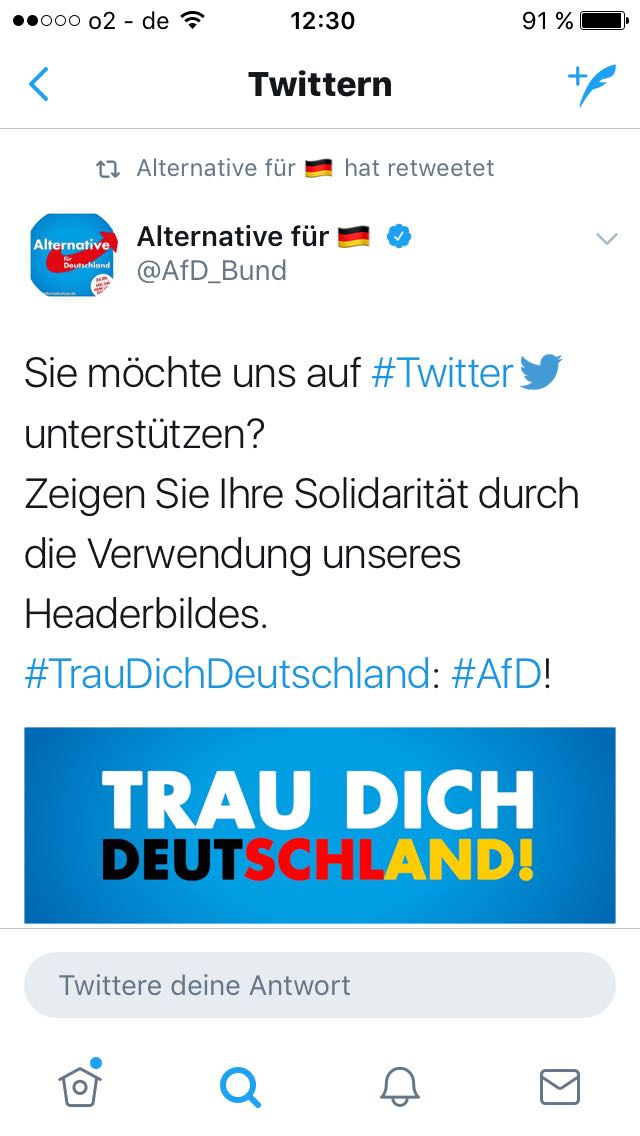 Screenshot: @afd_bund on Twitter Alternative for Germany tweets about the federal election under #TrauDichDeutschland. It appeals to supporters’ perception that taking certain positions requires “courage,” while incorporating a call to action in the hashtag. The hashtag is also the AfD’s election slogan and appears in its Twitter header. The party asks users to join in and use the slogan as their own header, fostering a sense of belonging. There is also a separate Twitter profile named “TrauDichDE.” Content-wise, the AfD relies on negative campaigning, as on its Facebook page. Its typical images again combine multiple elements: a photo, logo and different fonts. Alongside tweets containing statements, hashtags, mentions, links and emojis, this quickly looks overloaded: readers do not know where to look first. Lead candidate Alice Weidel and party chair Frauke Petry largely adopt the content tweeted on the party account, mainly posting and retweeting typical AfD graphics. This is rather dull for users. Beatrix von Storch’s Twitter presence is more conspicuous: her tweets have a provocative, sometimes inflammatory tone, for example, “Standing toilets for women. We are governed by complete idiots. #Berlin #Gaga #StopDenLänderfinanzausgleich.”
Successful microblogging: tips for Twitter
Twitter plays an important role in politics and the media public sphere, despite its niche reputation. Campaigners and businesses therefore need to present themselves properly here. How can Twitter be used effectively and professionally? Keep these tips in mind for your Twitter presence:
- Short, concise, easy-to-understand statements — you have only 140 characters.
- Evoke emotion with humorous, moving or provocative phrasing.
- Develop your own style in both content and wording, while considering your image and target audience. If you want to reach an older, conservative audience, a humorous style full of everyday glimpses and funny GIFs is probably less suitable. If you want broad appeal, as a lead candidate might, a narrow thematic focus is unhelpful. For a business, however, tweeting primarily about its core subject is advisable.
- Images and videos attract attention, but should fit the format.
- Original hashtags show creativity and build recognition. Otherwise, use meaningful hashtags and established ones where available, making the tweet easier to find.
- Where appropriate, tag relevant people and include background links.
- Provide variety: a good balance of your own content and retweets. Retweets should fit your page’s context.
- Connect to your other online channels, pointing to your Instagram or Snapchat profile or latest blog post, for example.
Still unsure how to use the microblogging service and need more input? Lilit supports parties and businesses with their social media planning. Simply send an email or call us directly. Curious for more tips? 1. Read how parties present themselves on Facebook and what we can learn from them 2. What matters in storytelling on Instagram during election campaigns 3. How to in election campaigning on Snapchat persuade
Read more
Related articles.
The next step